LUISA KOSTER
Big Title


A UI PROJECT AGAINST MASS CONSUMPTION
PIC ME is a speculative design project that examines how digital shopping platforms influence consumer behavior and encourage overconsumption.
By using familiar fast-fashion patterns, the project draws users into a typical buying experience and then intentionally disrupts it.
The moment of purchase reveals that no product is received, turning consumption into reflection and questioning the ethical role of design in digital commerce.
ROLE
Service Designer:
Research, System Thinking, Behavioral Analysis
UX/UI Designer:
Experience Design, Testing
CONTEXT
Interaction Design Project
Faculdade de Belas-Artes Universidade de Lisboa
Spring 2023
METHODS
Design research
Behavioral analysis
UX/UI design
Prototyping
Testing
Speculative storytelling
TEAM
Carolina Rosa Videographer
Doron Artsi Communication Designer
Joana Espadinha
Graphic Designer
Linda Gasser
Product Designer
Luisa Koster
Service Designer
Mentor:
Sónia Rafael
OUTCOME
PIC ME:
Interactive website and physical vending machine concept that simulates fast-fashion shopping, while intentionally subverting expectations to trigger reflection.
CONTEXT
Online shopping has become one of the most dominant ways people consume fashion today. Fast fashion platforms are designed for speed, convenience, and emotional engagement, making purchasing effortless and almost frictionless.
While awareness of environmental and social issues in the fashion industry is growing, purchasing behavior often remains unchanged. The distance between digital action and real-world impact makes overconsumption easy to ignore.
PROBLEMS
Online fashion shopping allows people to purchase clothing quickly, often without long decision-making processes.
The consequences of purchasing decisions are not visible within the digital shopping experience.
A large share of clothing items bought online are returned or discarded after only a few wears.
The number of online clothing purchases per person has increased significantly over the past decade.
Price, speed, and convenience are more prominent than long-term considerations in online shopping environments.
CHALLENGE
Online fashion shopping is not only a commercial or technological system, but also a space where everyday decisions are shaped. Digital shopping environments structure how people discover products, make choices, and complete purchases, often within seconds.
While fashion consumption increasingly takes place online, the design of these environments rarely makes the act of consumption itself visible. Decisions are embedded in interfaces, flows, and conventions that have become familiar and unquestioned.
Research Question:
How can a digital shopping experience encourage reflection on fashion consumption?
CHALLENGE FOCUS: Purchasing Phase
Within the context of this challenge, the purchase phase is identified as a key moment in the service journey.
It represents the point where digital interaction turns into commitment and connects the shopping experience with real-world consumption.
Because this decision is made within the service, yet its consequences unfold beyond it, the purchase phase becomes a critical moment to examine how reflection on consumption could be enabled through design.
Researching
Searching
Purchasing
Waiting
Getting the delivery
Unboxing
Wearing
-
Cognitive load is minimized
-
Commitment happens within the interface
-
Consequences occur beyond the screen
RESEARCH
To understand how digital shopping experiences shape purchasing decisions, research focused on everyday online fashion shopping behaviors.
The aim was to explore how decisions are made within digital shopping flows and how reflection is currently absent or limited in these moments.
Consumer Typologies
Although online shopping is now common across Western societies, consumers differ significantly in how they browse, decide, and purchase online. To capture these behavioral differences, McKinsey’s Media Matrix Model was used to cluster e-consumers based on usage and decision patterns rather than demographics.
For this project, the focus was placed on Surfers and Bargain Shoppers, as these groups are highly active in online fashion environments and frequently engage with browsing, deals, and trend-driven purchasing. Their behavior makes them particularly relevant when examining how digital shopping experiences influence consumption decisions.


The simplifiers
These Net users are impatient but lucrative. They spend just seven hours a month online yet account for half of all Internet transactions.
The surfers
These are consummate browsers and spend 32 percent time online. They look at four times more pages than other users.
The connectors
They are new to the Internet and less likely to shop. They also prefer brick‐and‐mortar brands they know.
The bargain shoppers
These are consumers who look out for bargains and enjoy finding good deals.
The routine followers
These are termed information addicts who frequent the Internet mainly for information.
The sportsters
These are sport enthusiasts and enjoy visiting sports and entertainment sites.
RESEARCH METHODS
Literature review
Research on online consumption, decision-making, and digital shopping behaviors
6 semi-structured interviews with focus users
Conducted with students and relatives to explore everyday shopping habits, motivations, and contradictions
Contextual observation
Observation of online shopping behavior to understand interactions, decision points, and friction within the shopping journey

System Map Section: Decision-Making in Online Fashion Shopping
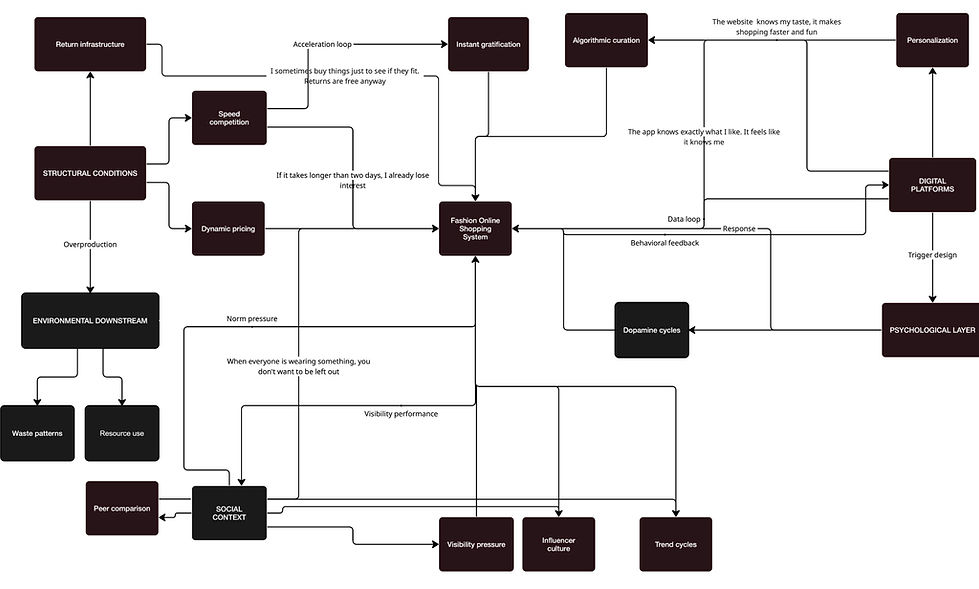
KEY INSIGHTS
Purchasing decisions are often made quickly and retrospectively justified
Interviewees frequently described making a purchase first and reflecting on the decision only afterwards, especially when products were framed as limited or time-sensitive.
Perceived scarcity strongly accelerates decision-making
Limited stock indicators and countdowns triggered urgency, leading users to act before fully evaluating their needs.
Purchasing decisions feel effortless at the moment of interaction but carry a strong sense of finality once completed
Interviewees described the purchase as quick and easy, yet mentally binding, with little opportunity for reconsideration.
Familiar shopping flows reduce perceived responsibility.
Repeated exposure to similar interfaces, discounts, and scarcity cues creates a sense of routine, lowering conscious engagement with the decision.
Reflection rarely occurs within the shopping journey itself.
Interviewees associated reflection with moments outside the platform, such as delivery, post-purchase regret, or realizing the limited use of the item.
DESIGN DECISIONS
The design decisions directly respond to the research question:
How can a digital shopping experience encourage reflection on fashion consumption?
Research showed that reflection rarely occurs during the shopping journey itself, as purchasing decisions are made quickly and feel mentally final once confirmed. Rather than trying to slow users down or prevent purchasing, the project intentionally works within familiar shopping behaviors.
Two parallel shopping environments were therefore designed:
A digital platform and a physical vending machine. Both replicate typical fast-fashion shopping patterns to meet users in contexts where impulsive and bargain-driven purchasing already takes place, online and in public spaces.
By maintaining familiar structures and interfaces, the project avoids disrupting the shopping flow and instead shifts reflection to a later moment, once the purchase has already been made.
Designing within familiar shopping patterns
Insight
Purchasing decisions are often made quickly and justified afterwards.
Design Decision
The experience deliberately follows familiar fast-fashion UI patterns to ensure users remain in an automatic shopping mode rather than entering a reflective mindset too early.
Focusing on the
purchase moment
Insight
The purchase phase feels simple, but final.
Design Decision
The intervention is placed after the purchase decision, allowing reflection to emerge only once commitment has already been made.
Extending the experience beyond the screen
Insight
Reflection rarely occurs within the shopping journey itself and often happens later.
Design Decision
The concept was expanded beyond the website into a physical vending machine, shifting the experience into real-world contexts where reflection is more likely to occur.
Reaching bargain-driven behavior in multiple contexts
Insight
Purchasing decisions feel effortless at the moment of interaction but carry a strong sense of finality once completed
Design Decision
By combining a digital shop with a physical vending machine, the concept addresses bargain-seeking behavior across environments rather than limiting it to a single channel.
MECHANISM
PIC ME deliberately uses dopamine-driven design patterns commonly found in fast fashion e-commerce. Bright visuals, fast interactions, urgency cues, and reward-like feedback encourage quick decisions and reduce conscious engagement with the information presented.
Although users are repeatedly informed that they are purchasing an image rather than a physical garment, these disclaimers are embedded within a highly stimulating interface. The design mirrors real-world shopping environments where critical information is often overlooked due to speed, familiarity, and emotional engagement.
This mechanism highlights how easily attention can be guided away from reflection, even when information is technically available.

INTERVENTION
To explore how a digital shopping experience can encourage reflection on fashion consumption, the intervention deliberately adopts the logic of fast fashion shopping instead of opposing it.
Rather than slowing users down or educating them upfront, the experience mirrors familiar shopping patterns and embeds reflection within the act of purchasing itself.
Reflection is not introduced as an explicit prompt, but as a consequence of the shopping experience.

DIGITAL SHOPPING EXPERIENCE
The website was designed to closely resemble common fast fashion e-commerce platforms, using dopamine-driven design patterns to encourage quick and intuitive purchasing.
Dopamine-driven design elements:
-
Bright, attention-grabbing visuals
-
Limited product descriptions
-
Emphasis on visual appeal over material details
-
Fast navigation between items
-
Minimal steps from product selection to checkout
-
Reduced friction through a simplified purchase flow
Although users in testing sessions informed that they are purchasing an image rather than a physical item, this information competes with persuasive interface patterns and is often overlooked during the buying process.


PHYSICAL SHOPPING EXPERIENCE PROTOTYPE
To extend the intervention beyond the screen, a physical shopping experience was created in the form of a clothing vending machine.
The machine resembles a futuristic retail device and was designed to attract attention in public spaces. Users can select and “purchase” clothing items, expecting a physical product to be dispensed. Instead, the machine prints out an image of the selected item.
This physical interaction amplifies the experience by:
-
Making consumption tangible
-
Creating public visibility around the purchasing moment
-
Generating curiosity and engagement through an unexpected retail format
REFLECTION MECHANISM: GARMENT WORKERS
After completing a purchase, users receive a printed card explaining that part of their payment was redirected to a garment worker in the mass clothing industry.
This moment connects the abstract act of online purchasing with the human labor behind fashion consumption. By revealing this information only after the transaction, the project shifts reflection to a point where the decision feels irreversible.
The reflection does not aim to induce guilt or prevent future purchases, but to surface the often-invisible relationship between consumption, labor, and responsibility.

EFFECT
For Online Shoppers
Experienced how easily purchasing decisions can be shaped by familiar digital shopping patterns.
Many users reported realizing only after the purchase that they had not bought a clothing item, but an image instead, triggering delayed reflection on their own consumption habits.
For Online Businesses
Highlighted how common persuasive UX patterns can drive purchasing without conscious engagement.
The project invites reflection on the ethical responsibility of designing frictionless shopping experiences.
For Society
Made the abstraction of fast fashion consumption tangible by disconnecting purchase from ownership.
By redirecting part of the spending to garment workers, the project reframed consumption as a social and economic relationship rather than a product transaction.
Open Question:
How can moments of reflection within consumption systems lead to lasting behavioral change beyond awareness alone?